
UNCORK LOUDOUN
Loudoun County is home to a diverse community of wineries, each contributing to the region’s growing reputation for quality and character. While all Loudoun wineries remain focused on direct-to-consumer sales, a select group of producers are currently participating in Uncork Loudoun’s trade distribution efforts, offering wines available for on-premise and retail placement through this initiative. The wineries listed below represent those actively working with Uncork Loudoun to expand distribution opportunities at this time.
Interested in learning more or purchasing wines from our portfolio? Contact our Loudoun Wine Sales & Brand Manager.

ANTOINETTE LANDRAGIN
antoinette@loudounwine.org
-
8 Chains North Winery
SAUVIGNON BLANC 2024
Technical Sheet - Bottle Shot‘FURNACE MOUNTAIN’ RED 2022
Technical Sheet - Bottle Shot -

868 Estate Vineyards
CHARDONNAY 2022
Technical Sheet - Bottle ShotMERITAGE 2022
Technical Sheet - Bottle Shot -
Bozzo Family Vineyards
PETIT MANSENG 2022
Technical Sheet - Bottle ShotPETIT VERDOT 2022
Technical Sheet - Bottle Shot‘SEI WHAT?’ RED BLEND 2019
Technical Sheet - Bottle Shot -

Cana Vineyards & Winery
CHARDONNAY 2024
Technical Sheet - Bottle ShotROSÉ OF CABERNET SAUVIGNON 2024
Technical Sheet - Bottle Shot -

Domaine Fortier Vineyards
CHARDONNAY 2020
Technical Sheet - Bottle Shot‘CHARBLANC’ 2024
Technical Sheet - Bottle Shot‘LE PIVOT’ RED 2020
Technical Sheet - Bottle Shot -

Endhardt Vineyards
‘REVERIE’WHITE 2022
Technical Sheet - Bottle ShotBLANC DE CAB FRANC 2023
Technical Sheet - Bottle Shot‘GOLDEN TURKEY’ RED 2021
Technical Sheet - Bottle Shot -
Fabbioli Cellars
‘SOMETHING WHITE’ 2024
Technical Sheet - Bottle ShotCABERNET FRANC 2023
Technical Sheet - Bottle Shot -
Good Spirit Farm Winery
PETIT MANSENG 2023
Technical Sheet - Bottle ShotRED BLEND 2022
Technical Sheet - Bottle Shot -

Hillsborough Vineyards
‘SEREFINA’ ROSÉ 2024
Technical Sheet - Bottle Shot‘BLOODSTONE’ RED 2021
Technical Sheet - Bottle ShotTANNAT 2020
Technical Sheet - Bottle Shot -

Iron Will Winery
PETIT VERDOT 2020
Technical Sheet - Bottle Shot‘VITRAUX’ RED 2022
Technical Sheet - Bottle Shot -
Lost Creek Winery
CHARDONNAY 2022
Technical Sheet - Bottle ShotCABERNET FRANC 2021
Technical Sheet - Bottle ShotPETIT VERDOT 2021
Technical Sheet - Bottle Shot -

October One Vineyard
VIOGNIER 2024
Technical Sheet - Bottle ShotMERLOT 2021
Technical Sheet - Bottle Shot -

Two Twisted Posts Winery
VIOGNIER 2022
Technical Sheet - Bottle ShotCABERNET FRANC 2020
Technical Sheet - Bottle Shot
LOUDOUN WINE REGIONS
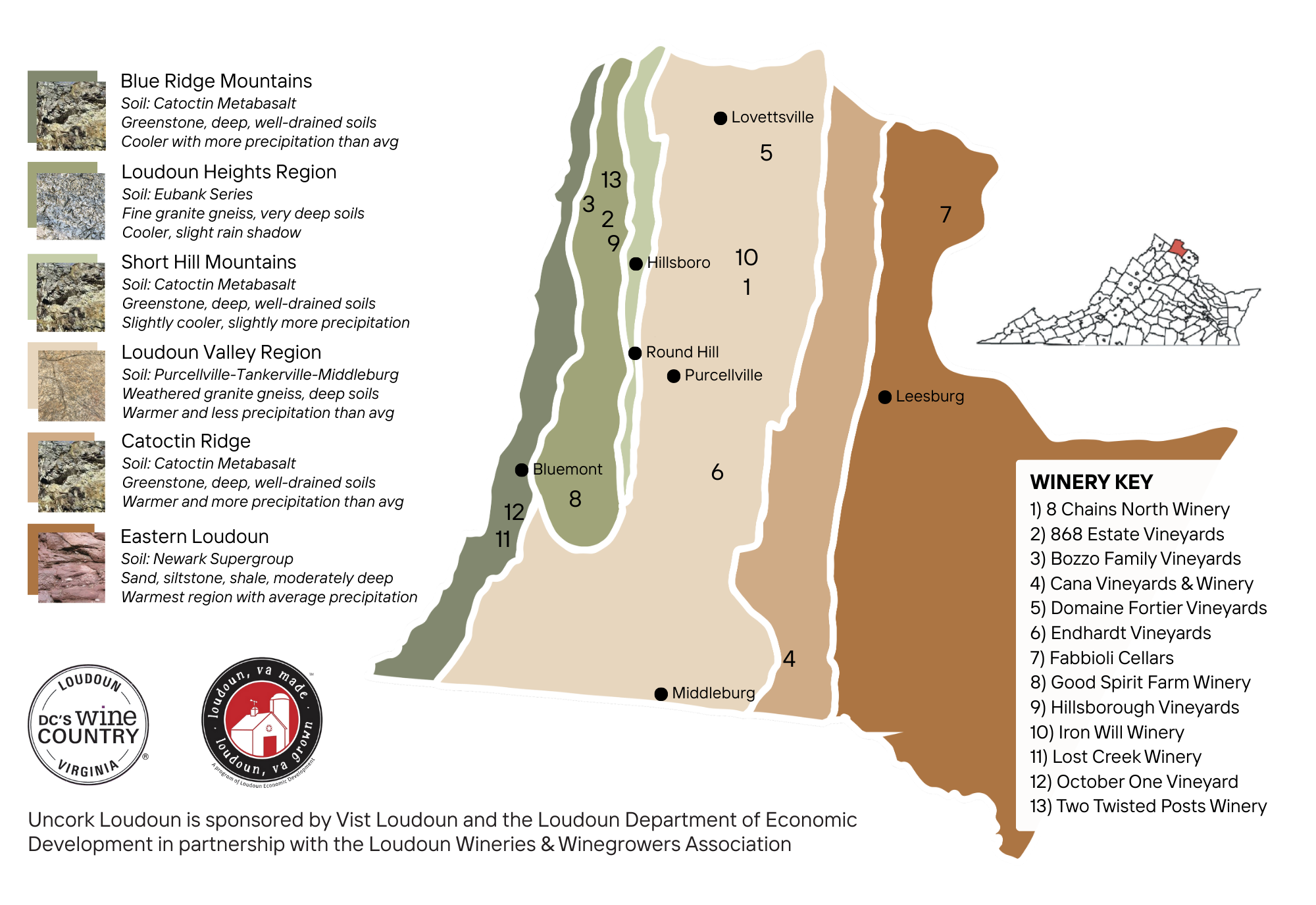
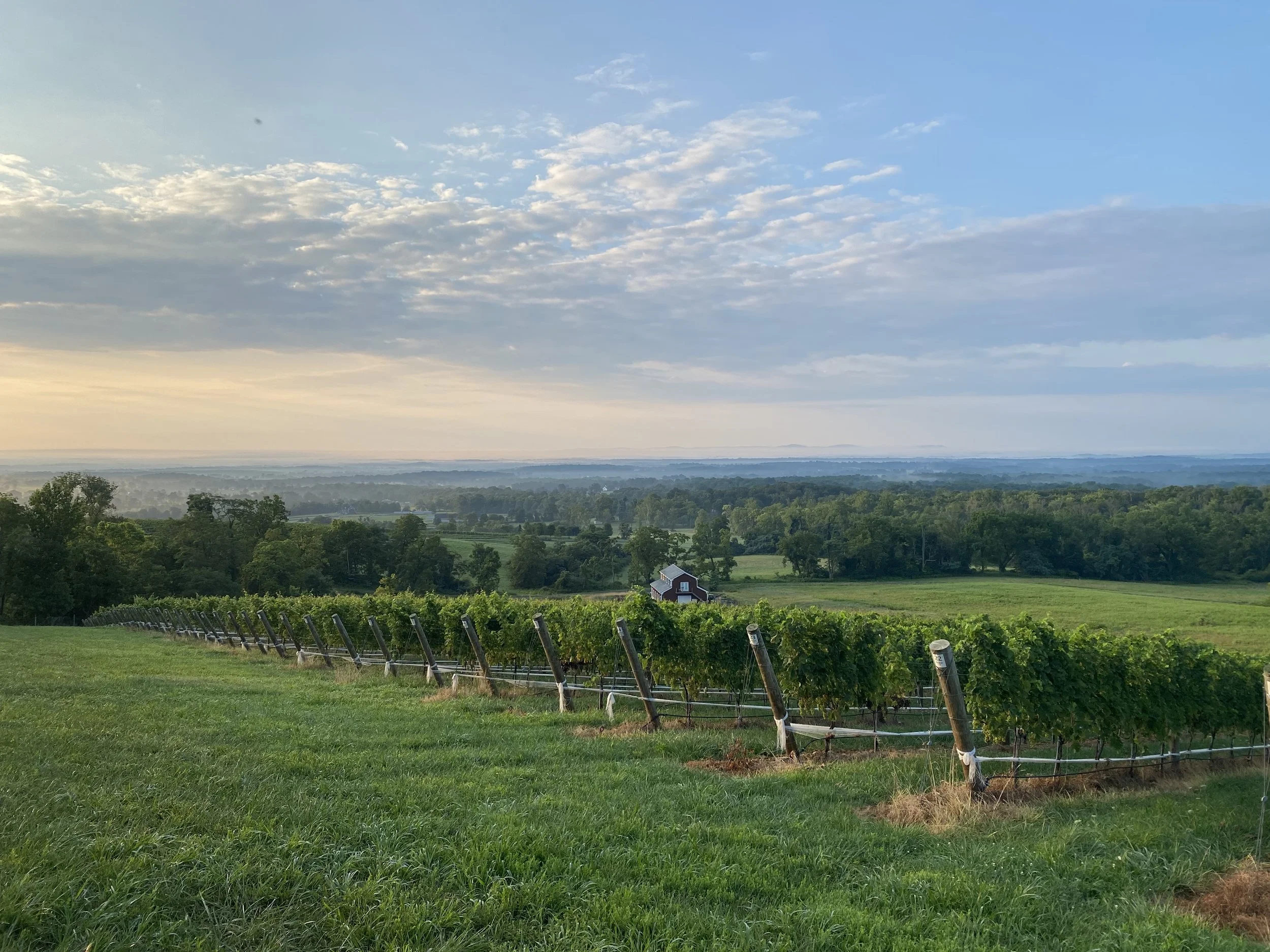
Loudoun County, Virginia sits at the intersection of complex geology, varied mesoclimate, and immediate access to one of the most influential wine markets in the country—Washington, DC. Stretching from the Blue Ridge Mountains through the Short Hill and Catoctin ridges into the warmer eastern piedmont, Loudoun is defined by a diverse mosaic of well-drained soils, including metabasalt and greenstone of the Catoctin Series, granite gneiss formations, and sandstone and shale of the Newark Supergroup.
From a climatic standpoint, Loudoun is best described as cool-to-moderate climate, averaging approximately 1,900–2,100 growing degree days (base 50°F), with meaningful variation by elevation, exposure, and topography. Higher-elevation western sites experience cooler temperatures, increased rainfall, and greater diurnal shifts, favoring aromatic whites and structured, acid-driven reds, while the central valley and eastern zones are warmer and drier, allowing for fuller phenolic development in red varieties.
The Loudoun Valley region falls within the Middleburg AVA, while growers in the Blue Ridge corridor are currently petitioning the TTB for recognition of a Bluemont AVA,. A second, follow-on AVA petition is also underway for the Loudoun Heights region.
As a result, Loudoun consistently excels with Cabernet Franc, Petit Verdot, Merlot, and Bordeaux-style blends, alongside Chardonnay, Viognier, Petit Manseng, Sauvignon Blanc, and Albariño. For the trade, these wines are defined by natural acidity, moderate alcohols, textural balance, and food-friendly structure, making them especially effective for by-the-glass programs, sommelier-driven wine lists, and curated retail selections.